In the fast-evolving world of additive manufacturing, print precision, speed, and reliability are directly influenced by one critical component—the LCD display.For resin 3D printers, especially MSLA and LCD-based systems, the display panel is not just a user interface; it is the core optical engine that determines print quality, layer accuracy, and curing efficiency.Choosing the best LCD display for 3D printers requires a clear understanding of resolution, light transmission, durability, interface compatibility, and long-term reliability.
At EUROTECH LCD, we specialize in custom 3D printer display solutions, offering high-resolution monochrome TFT, IPS, AMOLED, and industrial-grade display integration for next-generation 3D printing systems. With over 30 years of display engineering expertise, we help manufacturers build more advanced and reliable additive manufacturing equipment.
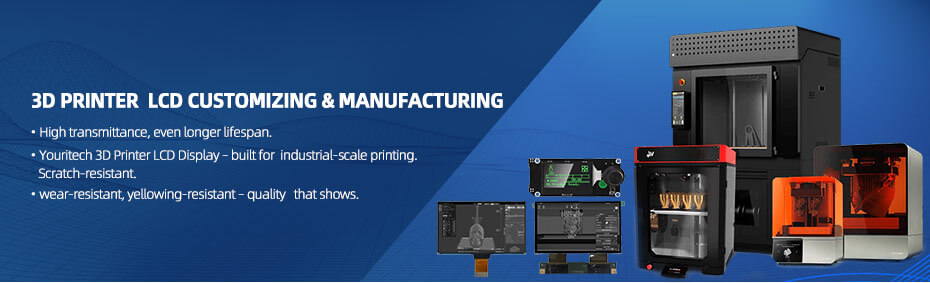
Why LCD Displays Are Critical in 3D Printing
In resin 3D printers, the LCD panel acts as a dynamic mask between the UV light source and the resin tank.
For every printed layer, the LCD selectively controls UV light exposure, directly affecting:
· Print accuracy
· Surface smoothness
· Layer curing speed
· Detail resolution
· Production efficiency
This means the quality of the LCD panel directly defines the final print quality.
A low-quality display may cause:
· Uneven curing
· Pixel defects
· Reduced lifespan
· Slower printing speed
· Lower precision
That’s why professional manufacturers prioritize industrial-grade monochrome LCD displays for 3D printers.
1. Choose the Right Resolution for Better Print Precision
Resolution is one of the most important factors.
Higher resolution means:
Sharper print details
Smoother surfaces
Better dimensional accuracy
More precise edge definition
For modern resin 3D printers, common resolutions include:
· 4K LCD Display – Ideal for entry-level precision printing
· 8K LCD Display – Better for professional prototyping
· 9K LCD Display – High-detail industrial applications
· 14K LCD Display – Ultra-fine precision manufacturing
EUROTECH provides advanced options such as:
· 6.2” 4K (3840×2400)
· 6.8” 9K (8520×4320)
· 9.9” 8K (7680×4320)
· 10.1” 14K (13320×5120)
Higher resolution delivers higher pixel density, which is essential for dental, jewelry, and precision engineering printing.
2. Monochrome vs RGB LCD: Which Is Better?
This is one of the most common questions.
Monochrome LCD
Advantages:
· Higher UV transmission (90%+)
· Faster curing speed
· Longer lifespan
· Better energy efficiency
Best for:
· Industrial resin printers
· Professional prototyping
· High-speed production
RGB LCD
Advantages:
· Lower cost
· Suitable for hobby printers
Disadvantages:
· Lower UV transmission
· Slower print speed
· Shorter lifespan
For most professional applications, monochrome LCD displays for 3D printers are the best choice. EUROTECH’s 3D printer product line focuses heavily on monochrome technology for this reason.
3. Consider Display Size Based on Build Volume
Screen size determines maximum print area.
Common sizes include:
· 4.6 inch — Compact desktop printers
· 5.5 inch — Entry-level resin printers
· 6 inch — Standard precision systems
· 7 inch — Professional printers
· 10.1 inch+ — Large-format industrial printers
For example:
EUROTECH’s ET0603D01-D uses a 6-inch 1620×2560 monochrome TFT optimized for compact high-resolution printing.
Larger displays allow larger build volumes without sacrificing resolution.
4. Pay Attention to Light Transmission Efficiency
Light transmission affects print speed.
The higher the UV transmittance, the faster the resin cures.
Important factors:
· Panel structure
· Polarizer efficiency
· Glass thickness
· Surface coating
Industrial-grade monochrome LCDs significantly outperform RGB displays in UV efficiency.
This improves:
· Production speed
· Exposure consistency
· Resin curing accuracy
5. Evaluate Temperature Stability and Lifespan
3D printers generate heat continuously.
A high-quality LCD must support stable operation under long printing cycles.
Look for:
· Wide operating temperatures
· Heat resistance
· Long working life
· Stable optical performance
EUROTECH industrial displays support operating ranges from -20°C to 70°C, making them suitable for industrial environments.
Longer lifespan reduces replacement frequency and maintenance costs.
6. Check Interface Compatibility
Display integration must match your motherboard architecture.
Common interfaces include:
· MIPI
· eDP
· HDMI
· SPI
· RGB
· LVDS
EUROTECH offers both MIPI and eDP display solutions for 3D printer integration.
This ensures flexible compatibility for OEM and ODM development.
7. Customization Matters for Competitive Advantage
Standard LCD modules may not fit all machine architectures.
That’s why customization is increasingly important.
EUROTECH supports:
· Custom display sizes
· Custom glass thickness
· Optical bonding
· UV optimization
· Industrial-grade cover lens
· Embedded integration
· High-temperature materials
For manufacturers developing next-generation 3D printers, custom display engineering creates better product differentiation.
Future Trends in 3D Printer LCD Technology
The future of 3D printer LCD displays is moving toward:
· Higher resolution (16K+)
· Faster refresh rates
· Better UV transmission
· Larger build areas
· Longer panel lifespan
· More energy-efficient designs
As the 3D printing market grows, display technology will continue to define speed, precision, and manufacturing capability.
Why Choose EUROTECH LCD for 3D Printer Displays?
EUROTECH is a global leader in custom industrial display solutions, with deep expertise in:
Monochrome TFT LCDs
IPS Displays
AMOLED Displays
High-resolution 3D printer displays
Optical bonding solutions
Custom glass integration
Industrial display customization
Full OEM/ODM manufacturing
With decades of R&D and manufacturing experience, EUROTECH helps customers accelerate product innovation and improve print performance.
Whether you need a 4K, 8K, 9K, or 14K LCD display for your 3D printer, EUROTECH provides complete custom display solutions for your project.
Conclusion
Choosing the best LCD display for 3D printers is essential for improving print precision, speed, and long-term reliability.
When evaluating a display, focus on:
· Resolution
· Monochrome technology
· Display size
· UV transmission
· Temperature stability
· Interface compatibility
· Customization capability
If you’re developing advanced resin 3D printers, EUROTECH LCD can provide the custom display technology you need to stay ahead in the additive manufacturing market.